
InterPore News featuring: The 2025 Annual Report

Sent on: 02-10-2026

Dear InterPore colleagues,

Make things as simple as possible, but not simpler, according to Einstein. That crossed my mind when reading one of today's promoted papers and during a PhD defense earlier this week, both discussing the use of REV. It works for porosity, but does it work for transport properties? In theory perhaps yes, but also at a scale that would be useful? Similar considerations can be made in for example epidemiology and house markets. It works on the population level, but what should I choose on an individual level? Do we have an alternative for REV that is practically feasible…?

Something very simple and clearly written is the InterPore Annual Report. The excitement for InterPore2027 is also pure and simple. And because that is still some time away, we have great webinars, courses and Chapter meetings coming up! Simply sign up!

All the best,

Matthijs de Winter
Editor-in-Chief
InterPore News


Here you can find news and updates to the upcoming Annual Meeting in Rio de Janeiro.


Submission of proposals for Conference Courses at InterPore2027 is now open! Courses will be organized as satellite events of the InterPore Annual Meeting in Rio de Janeiro on the following dates:

  • Sunday, 9 May 2027
  • Friday, 14 May 2027

Standard duration of a given course will be half a day (3-hour lecture). Proposals for non-standard duration, if well justified, will be considered. Main criteria for selection of proposals include track record of the proposers as well as the opportunity to ensure diversity to a full extent across all courses.

To submit your proposal, please complete the submission form.


We are pleased to announce that InterPore Foundation would once again like to offer a number of conference grants to researchers from academic institutions from countries with low- or middle-income economies, as defined by the World Bank, and to graduate students, to support participation in the InterPore2027 Conference.

In addition to covering the conference registration fee, a select number of grants will also provide up to €500 toward travel costs.

Who Can Apply?

To be eligible, applicants must:

  • Be presenting at InterPore2027
  • Hold a current InterPore membership
  • Submit a CV and letter of justification with their online application

Applications are reviewed by a dedicated committee based on academic achievement and the quality of the research abstract.

Deadline: 15 January 2027 (no applications will be accepted after this date, no exceptions). The winners will be announced by mid February.

We encourage eligible researchers and students to take advantage of this opportunity and apply for support to attend InterPore2027.


The InterPore2027 Programming Committee announces the introduction of seven new minisymposia, highlighting the continued growth and interdisciplinary reach of the InterPore community.

These new sessions cover topics including phase-change processes in porous media (such as evaporation, freeze-thaw phenomena, and reactive transport that alters pore structures), induced seismicity due to e.g. geothermal energy production, biomedical and biological applications, colloid and particle transport, and the development of open-source software tools. 

We look forward to welcoming researchers interested in exchanging ideas in these areas to InterPore2027.


Christ the Redeemer and Corcovado. Christ the Redeemer awaits InterPore2027 participants with arms wide open! Standing atop Corcovado Mountain since 1931, this iconic monument is one of the New Seven Wonders of the World. During your stay in Rio de Janeiro, reach the summit by train, official van or hiking trail and enjoy sweeping views of Guanabara Bay, Sugarloaf Mountain, Maracanã Stadium and the Atlantic Ocean. A memorable addition to your InterPore2027 experience! Ready, set... Rio!

Photo credit:  All Rights Reserved Riotur. Photo: Fernando Maia | Riotur
Text: Anderson Camargo Moreira


Here you can find news and updates to ongoings within the Society.


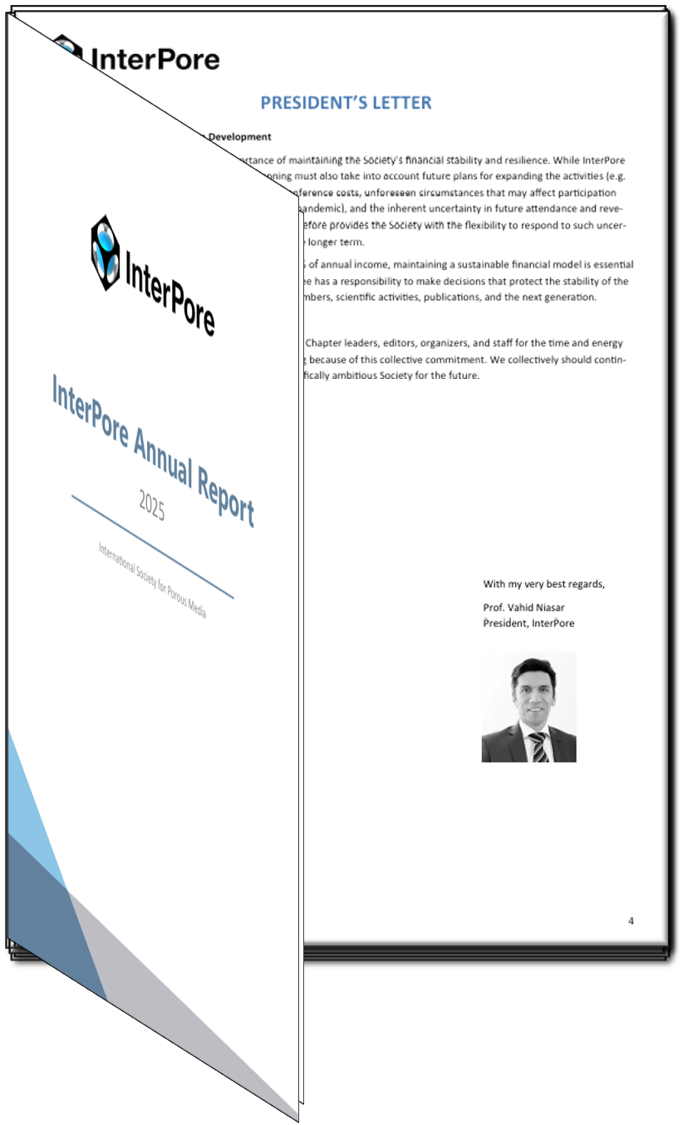
The InterPore Annual Report for 2025 is now available on our website, featuring highlights from our Annual Meeting, leadership, finances, awards, Journal, Academy, National Chapters, Foundation, and more. We invite you to take a look and learn more about the Society’s work over the past year.


This year, members will elect:

  • One President-Elect
  • Five Council Members
  • Three members of the Student Affairs Committee (SAC)

Meet the President-Elect Candidates

Two candidates are standing for election as President-Elect of InterPore. We invite members to learn more about their backgrounds, experience, and vision for the Society before casting their vote.

President-Elect candidates are:

  • Linda Abriola, Brown University, USA
  • Bo Guo, University of Arizona, USA

Candidate profiles and additional information are available on the InterPore Elections webpage.

Mark Your Calendar

Voting period: 1-30 November 2026

Your participation matters. We encourage all current InterPore members to take this opportunity to engage in the Society’s elections and help shape the future of our community.


Meet Our New Social Media Team Volunteers

We are pleased to welcome Faraz Sufyan and Dr Amina Muhammad Mustapha to the InterPore Social Media Team. We look forward to their contributions—welcome to the team, Faraz and Amina!

Faraz is a PhD student in the Department of Energy and Petroleum Engineering at the University of Wyoming, USA, researching flow behaviour in rough channels and porous media. He will contribute short, AI-assisted videos to make porous media science and its applications accessible to a wider audience.

Amina is a lecturer in the Department of Pure and Applied Chemistry at Kaduna State University, Nigeria. She will support social media content and engagement, helping InterPore connect with its community.

Meet the InterPore Community: National Chapters are dynamic, country-wide groups within InterPore that bring together researchers, professionals, and students working in porous media science and engineering. These chapters act as local hubs for scientific exchange, collaboration, and networking, while contributing to the global mission of InterPore.


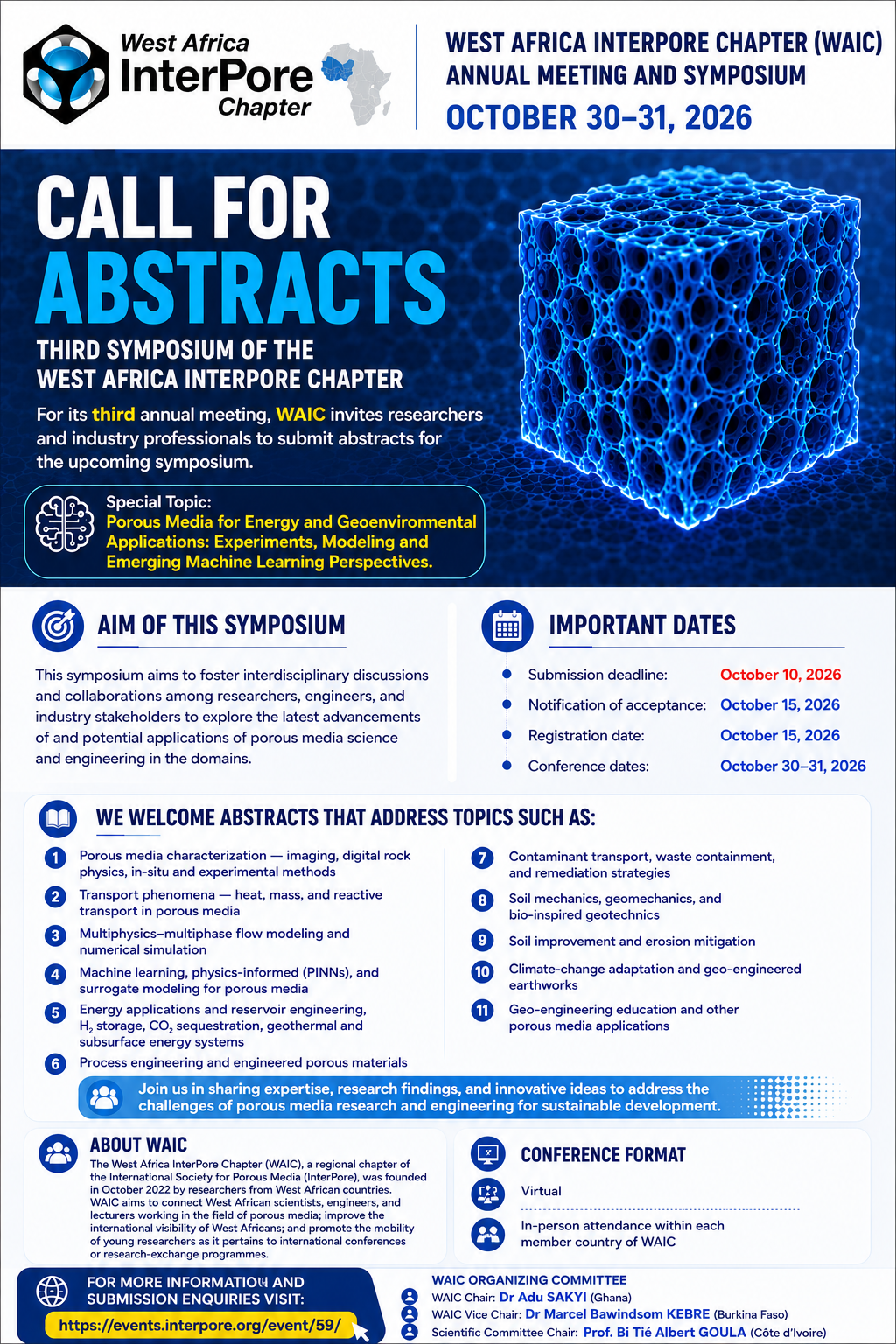
The Third Symposium of the West Africa InterPore Chapter will take place from 30-31 October 2026.

Pre-symposium courses for PhD students will be held on Thursday, 29 October 2026, covering Python, Machine Learning/Deep Learning, and Physics-Informed Neural Networks (PINNs).

View the flyer here.

Submit your abstract by 10 October 2026!


InterPore Awards

Do you know a colleague whose outstanding contributions to the porous media community deserve recognition?

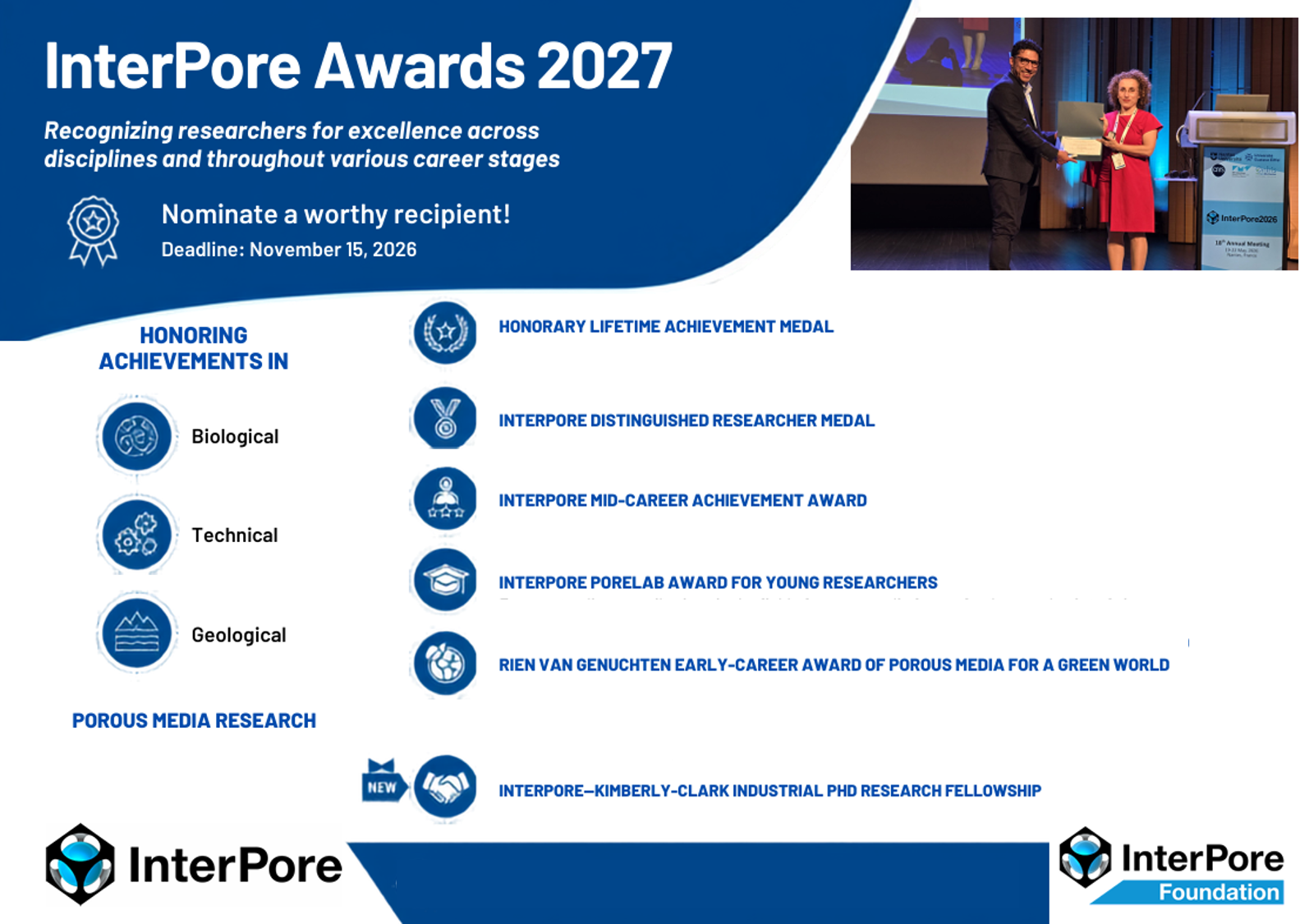
The call for nominations for the 2027 InterPore Awards is open! We encourage InterPore members to nominate a deserving colleague whose research, contributions, or service have made a meaningful impact on our field and community.

Take this opportunity to recognize the achievements of a colleague and help celebrate the excellence and dedication within the InterPore community.

For award categories, eligibility criteria, nomination details, and deadlines, please visit the InterPore Awards webpage.


Here you can find updates to the Academy's events promoting education, training, and research through a variety of activities, including courses, webinars, thematic workshops, and initiatives by the Young Academy.


PORE 2-2 led by Maja Rücker (Eindhoven University of Technology, The Netherlands), Catherine Spurin (Stanford University, USA), and Benzhong (Robin) Zhao (McMaster University, Canada) on imaging porous media across scales. Check it out here: Academy Course: PORE 2-2

PORE 2-8.1 led by Hadi Hajibeygi (Delft University, the Netherlands) to gain an in-depth knowledge and hands-on experience with multiscale simulation of multiphase flow in fractured reservoirs.
Check it out here: Academy Course: PORE 2-8.1


News, events and activities from all around the porous media community


InterPore congratulates Bo Guo, Associate Professor at the University of Arizona and Chair of the InterPore Membership Committee, on receiving the 2026 AGU (Hydrology Section) Hydrologic Sciences Early Career Award.

This award is presented annually and recognizes outstanding contributions to hydrology through research, education, or societal impacts. Successful nominees are early-career scientists who demonstrate outstanding contributions to hydrologic sciences, education, or societal impacts and show exceptional promise of continued contributions to hydrology throughout their career.

Congratulations to Bo Guo on this well-deserved recognition!


InterPore Members can promote their publications to the community via the InterPore InJournals section of the Newsletter. If you wish to do so, please submit your publication highlight to newsletter@InterPore.org. Clearly indicate which of the authors is an InterPore member (or the institute with an Institutional Membership). Note that we will not review the entries nor does InterPore endorse the published work. Furthermore, we publish on a “submitted first, published first” basis. The highlighted publication should be no older than 6 months (available online).
The highlight should be short (max. 100 words) and contain an illustration. Please note that we offer this opportunity exclusively to InterPore members. If you would like to become a member, please have a look here.


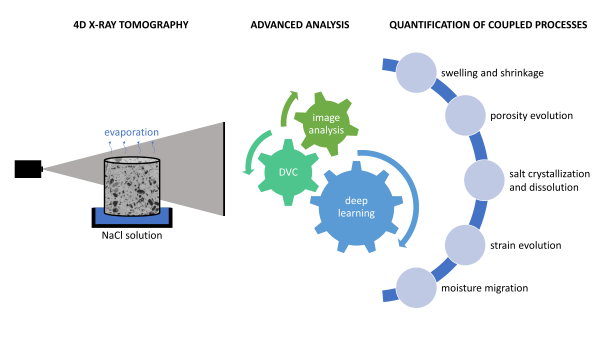
Ben Elhadj Hamida, S., Boone, M.A., Cnudde, V., Moonen, P., Derluyn, H.

Salt silently cracks stone buildings and monuments from the inside out, threatening cultural heritage worldwide. Using X-ray imaging without a contrast agent, we developed a novel analysis workflow that reveals how salt is transported and creates cracks at a microscopic scale. This workflow opens new ways for scientists to study similar complex processes in porous materials. The insights inform conservation experts and engineers as they develop strategies to protect materials, buildings, and structures from salt weathering.


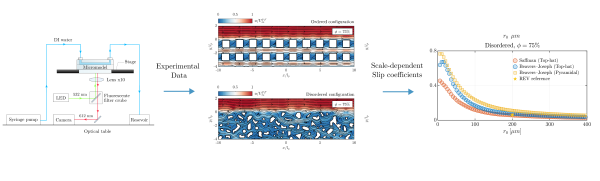
Mario Del Mastro & Alexandros Terzis

Predicting flow at fluid–porous interfaces remains challenging due to the scale dependence of interfacial slip parameters. Experiments across ordered and disordered porous structures demonstrate that slip coefficients depend on both pore-scale geometry and spatial averaging. These results establish the need for consistent averaging procedures to ensure reliable characterization and comparison of interfacial flow.


If you have a job opening in your institute and would like to promote it internationally, please send the description and weblink or PDF to newsletter@interpore.org, and we'll be happy to add it to the list.
It is also possible for Members to post the position on the InterPore website. Log in through MyInterPore and click "Submit a Job Opening."

Explore our list of upcoming events and join us to connect, learn, and share insights!